Introduction
Building backlinks is only one part of improving a website's search visibility. After publishing articles, creating profiles, submitting business listings, or sharing content on third-party platforms, many website owners expect Google to discover every page automatically.
In reality, some pages appear in search results while others remain undiscovered or unindexed. A link may be visible to visitors even when the page containing it is not included in Google's index.
This creates an important distinction between having a backlink and having a backlink on an indexed page.
For businesses such as CreativeDudes, which publishes marketing insights and maintains profiles across several platforms, understanding this distinction can make backlink management more organised. Instead of creating more links whenever an existing one appears unindexed, the better approach is to investigate the current placements and identify what can realistically be improved.
What Is the Difference Between a Live Backlink and an Indexed Backlink?
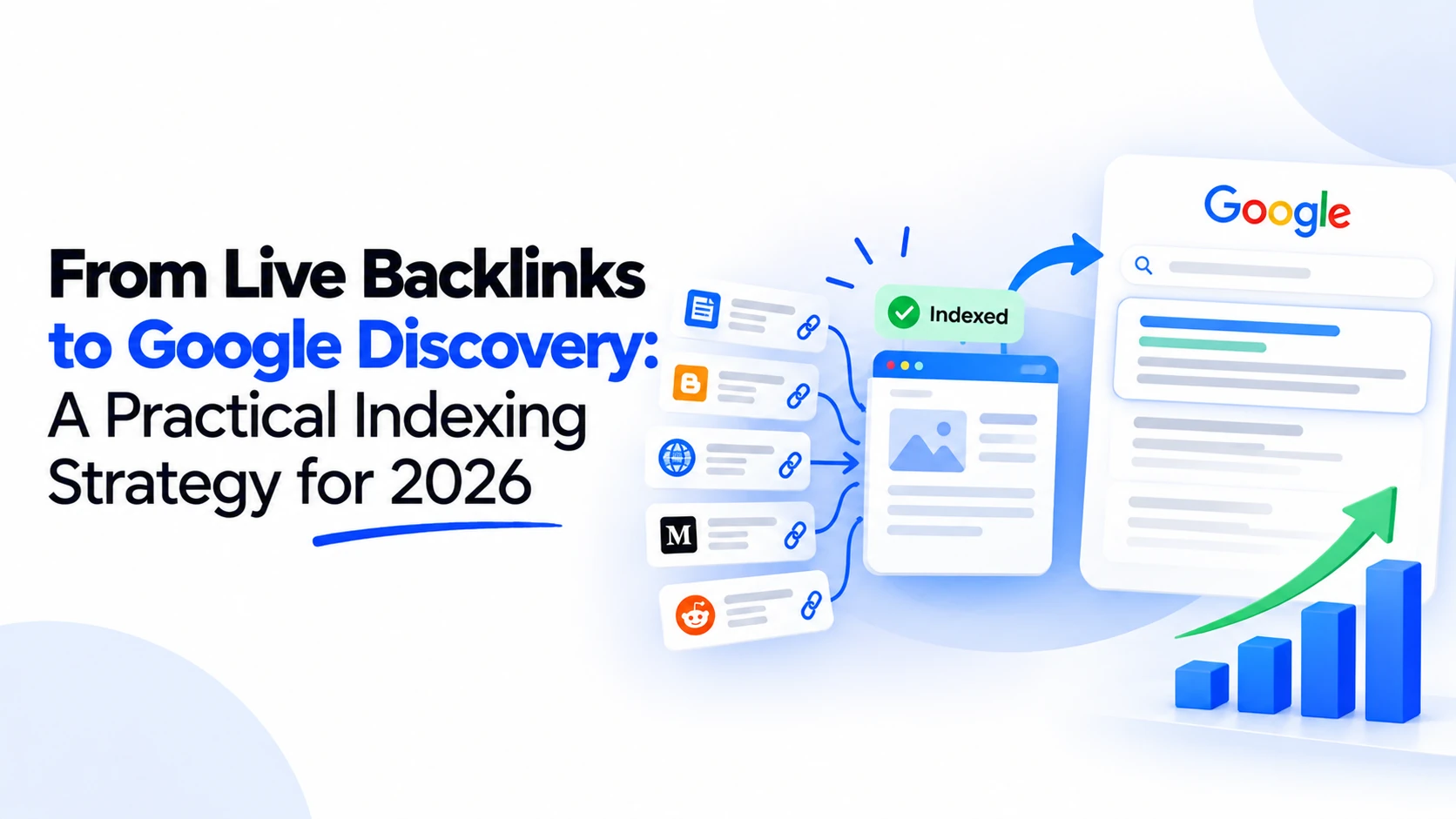
A live backlink is a link that appears on an accessible webpage and points towards another website. An indexed backlink is a link located on a page that Google has included in its search index.
These are not the same thing.
Consider a business that publishes an article on an external blogging platform. The article opens correctly, contains a website link, and is publicly accessible. These observations confirm that the placement is live, but they do not prove that Google has indexed the article.
The process generally involves three stages:
Discovery: Google learns that the URL exists, potentially through a link or sitemap.
Crawling: Googlebot accesses the page and processes its available content.
Indexing: Google evaluates the page and may add it to its search index.
A page can be discovered without being crawled, or crawled without being indexed. Google does not guarantee inclusion simply because a URL has been published or submitted.
Read Google's official guide to crawling and indexing problems to understand how these stages differ.
Step 1: Audit Your Existing Backlink Placements
Before attempting to improve indexing, check whether each backlink has been published correctly.
Open the referring page and confirm that it loads, displays the expected content, and contains a working link to the intended destination. Check whether the page is public, whether the link points to the correct URL, and whether the content remains published.
Also identify duplicate entries in your backlink spreadsheet. For example, a single bookmarking page might appear several times in a working list. Counting it as multiple unique pages can make the backlink inventory look larger than it actually is.
A useful audit should record the referring URL, destination URL, anchor text, platform, date checked, live status, and any available indexing evidence.
Do not treat a submitted profile, a saved bookmark, and a published article as interchangeable. Each is a different type of placement and should be assessed according to its actual purpose.
Step 2: Check Why a Referring Page May Not Be Indexed
Once you confirm that the backlink is live, investigate whether Google can crawl and potentially index the source page.
Check Page Accessibility
If a page is unavailable to visitors or requires authentication, Google may be unable to access its content. Temporary server errors and deleted pages can also interrupt crawling.
Review Crawling and Indexing Restrictions
A page may be affected by robots.txt rules, a noindex instruction, or other technical restrictions. These mechanisms have different purposes, so identify the actual restriction before deciding what to change.
Google explains how website owners can use noindex instructions to prevent pages from appearing in search results.
If the page belongs to a third-party platform, you may not have permission to change its settings. Record the issue instead of repeatedly submitting the same URL.
Consider Duplication and Content Quality
Google may select a preferred canonical URL when similar pages exist. It may also decide not to index a page that does not provide sufficient independent value.
Publishing many profiles with identical descriptions or distributing substantially similar articles across multiple platforms does not guarantee that all versions will be indexed.
Step 3: Use Existing Articles to Build Meaningful Content Relationships
Relevant content can help readers move between related topics and provide additional ways for crawlers to discover pages.
For example, an article discussing website visibility can naturally reference local SEO strategies for small businesses.
A discussion about brand presentation may point towards an article explaining why professional graphic design matters to businesses. A section comparing search optimisation methods can reference on-page SEO versus off-page SEO.
Similarly, content about agency selection may be supported by a practical guide to choosing a digital marketing agency in Ahmedabad.
Each link should help readers understand the subject, find a useful example, or explore a related question. Avoid adding links purely because a destination is missing from your backlink tracking sheet.
Search engines and readers both benefit from clear, meaningful relationships between pages.
Step 4: Organise Backlinks According to Their Purpose
A backlink audit becomes easier when different placements are grouped by their role rather than treated as one large collection of URLs.
A business may publish long-form articles, maintain professional profiles, share creative resources, and submit directory listings. These assets have different audiences and should not all be managed in exactly the same way.
Editorial Articles and Publishing Platforms
Long-form content should offer readers useful information beyond a business name and a website link.
CreativeDudes has publishing resources covering subjects such as digital marketing costs in India in 2026, AI copywriting tools, and branding strategies.
Other content assets include a guide to digital marketing services and costs in Ahmedabad and a separate resource about the importance of graphic design for businesses.
These articles should be evaluated individually. Check whether each page is accessible, provides original value, and contains the intended link.
Profiles and Community Publishing
Professional profiles help people find a business or its published work across different platforms. Their primary value may be reputation, referral opportunities, or audience discovery rather than search ranking alone.
A backlink inventory might include the CreativeDudes Medium profile, Substack profile, Blogger profile, and LiveJournal profile.
Community and publishing profiles include Product Hunt, Quora, Reddit, and DEV Community. Other community-oriented profiles include Wattpad and Ranker.
These platforms should be used according to their audience and publishing rules. A useful contribution to a relevant discussion is more meaningful than repeatedly placing promotional links without context.
Business Directories and Company Listings
Business directories can help establish an organisation's public presence and offer another way for potential customers to discover its services.
For example, an audit can include the CreativeDudes listings on Pick an Agency, Sortlist, Blinx, and Wellfound.
It can also include the SourceForge profile and a related Google Business Profile audit resource.
When checking these placements, verify the business details, page accessibility, and actual link destination. Do not assume that a listing is valuable merely because the directory has an established name or a high third-party authority score.
Bookmarking and Content-Curation Platforms
Bookmarking and curation services can organise links to useful resources, but a saved item is not automatically an indexed webpage or a high-value backlink.
An audit may cover the Wakelet collection, an Instapaper resource folder, and the Diigo profile.
Additional saved resources may appear on Padlet entry one, Padlet entry two, and Padlet entry three.
The same inventory can contain distinct Moptu entry one, Moptu entry two, and Moptu entry three.
The purpose of tracking these URLs is to verify what exists and identify which pages are worth maintaining, not to assume that every saved item will enter Google's index.
Creative Portfolios, Media, and Other Profiles
Visual and presentation platforms can serve as portfolios or supporting channels for creative work. Depending on the platform, the published asset may offer more value to visitors than the profile link itself.
For a complete audit, include the Vimeo profile, DeviantArt profile, and Instructables profile.
You can also record the Issuu profile, Speaker Deck profile, and Gravatar profile.
For visual assets, include the 500px profile and Unsplash profile. The Launchpad profile provides another distinct URL to monitor.
There is also a LiveJournal published post. Alongside the profile itself, this post should be tracked as a separate page because an individual published article and a user profile have different URLs and potentially different indexing statuses.
Step 5: Use Google Search Console for Pages You Manage
Google Search Console is useful for checking indexing information on websites you own or have permission to manage.
Use URL Inspection to examine an important URL and review Google's reported discovery, crawling, and indexing information. When available, the live test can help identify current access problems, although it cannot guarantee inclusion in search results.
For your own website, maintain an updated XML sitemap containing the canonical pages you want Google to discover. Use clear internal links to connect related articles and service pages.
Google's URL Inspection documentation explains the available status information. Its recrawl guidance also makes clear that indexing requests do not guarantee inclusion.
There is one crucial limitation: you generally cannot request indexing through your own Search Console property for external backlink URLs that you do not manage. You may be able to improve the content through the relevant publishing platform, but the platform ultimately controls its technical settings.
Step 6: Build a Realistic Indexing Workflow
Rather than submitting every URL repeatedly, divide the work into four stages.
Week 1 - Verify the placements. Open each unique backlink URL and confirm that the page exists, the intended link is present, and the destination is correct.
Week 2 - Identify restrictions. Check for deleted pages, crawling barriers, redirects, and other obvious technical problems. Separate issues you can fix from issues controlled by another platform.
Week 3 - Improve content quality. Where you control the content, make it genuinely useful, remove unnecessary duplication, and connect related articles through appropriate contextual links.
Week 4 - Review the evidence. Use Search Console for your own pages and maintain a record of what is confirmed, what remains uncertain, and what requires further attention.
For third-party pages, use available public evidence cautiously. A site: search can help locate results, but it should not be treated as a definitive indexing report.
Common Backlink Indexing Mistakes to Avoid
Several habits create more work without solving the underlying problem.
Repeatedly requesting indexing does not force Google to include a page. Adding irrelevant links to an article can make the content less useful. Copying the same description onto dozens of profiles can create repetitive pages with limited independent value.
Another mistake is treating every directory listing or profile as an equally valuable backlink. Placement quality, contextual relevance, link attributes, crawlability, and the destination all matter when evaluating a link.
Finally, do not assume that a page's absence from search results proves the backlink has been deleted. Verify the live page separately from its indexing status.
Conclusion
Moving from live backlinks to Google discovery requires a structured approach. Verify the published link, check the referring page's accessibility, assess its content quality, and track the indexing evidence available to you.
For CreativeDudes, the goal should be to maintain a clear inventory of existing publishing pages, profiles, directories, and curated resources. Every URL should have a documented status and an appropriate purpose rather than being judged solely by whether it appears in a search result.
A well-organised backlink audit will not guarantee that Google indexes every page, but it will help identify technical problems, reduce duplicate effort, and focus attention on placements that genuinely support your online presence.