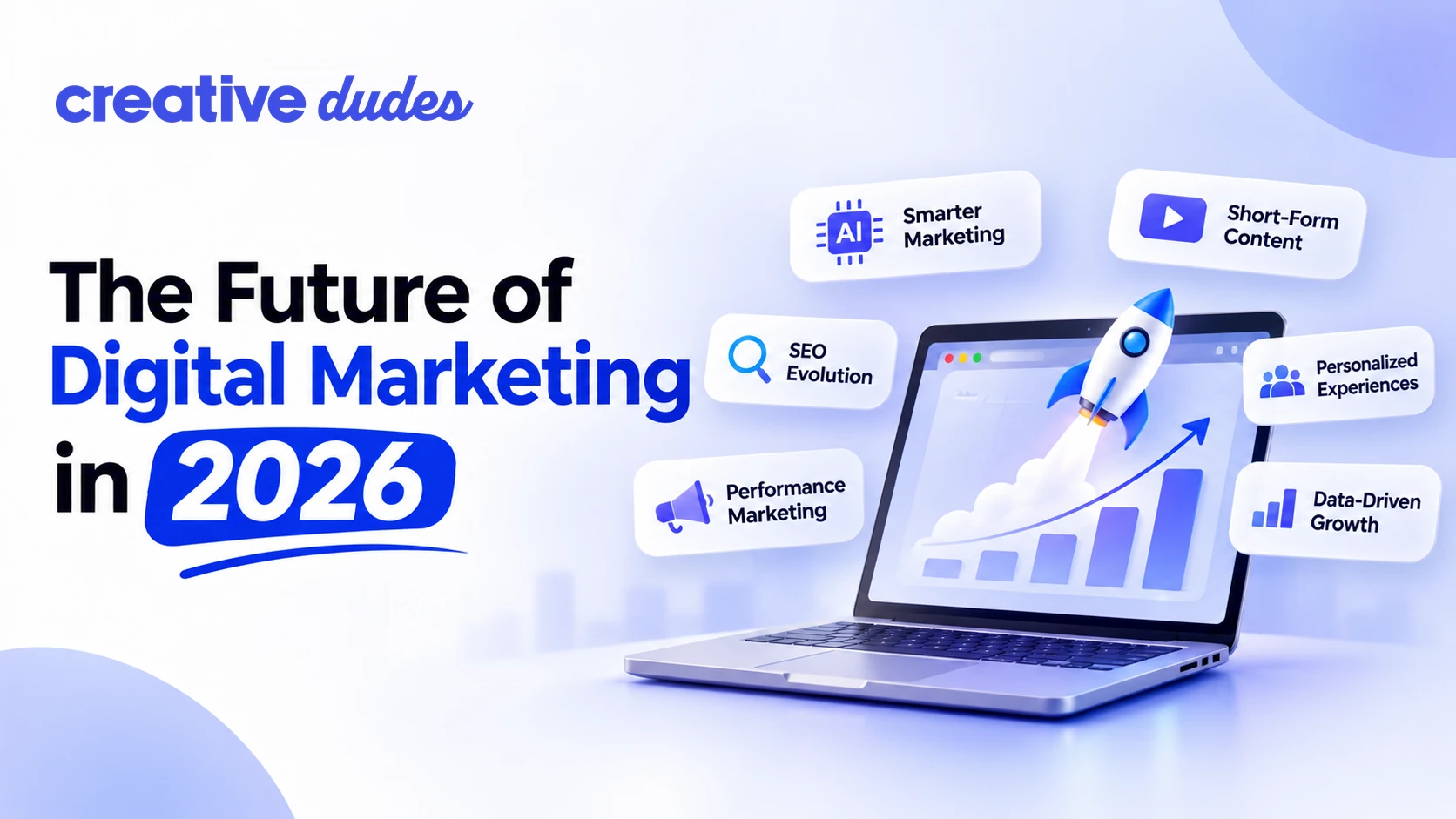
Introduction
Digital marketing has changed significantly over the years. Search engines, social media platforms, online advertising, and content marketing have created new ways for businesses to reach potential customers.
More recently, artificial intelligence and automation tools have introduced additional possibilities for planning, creating, and analyzing marketing activities.
But what could the future of digital marketing look like?
Although nobody can predict every change with certainty, current developments provide useful clues about areas businesses may want to explore. Some technologies may become more widely adopted, while others may develop differently than expected.
For businesses, the goal should not be to follow every new trend. It should be to understand which developments are relevant to their customers and make informed decisions based on their needs, resources, and results.
Let's explore some of the developments that could influence digital marketing in 2026 and beyond.
1. How AI Could Influence Digital Marketing
Artificial intelligence is already being used in several marketing activities, including content assistance, data analysis, customer segmentation, and workflow automation.
As these tools continue to develop, businesses may find additional ways to incorporate AI into their marketing processes. However, the extent of adoption will likely vary depending on the business, the technology available, and the task involved.
For example, a small business might use AI to generate initial blog ideas, organize customer feedback, or summarize campaign data. A larger marketing team might explore more advanced applications involving customer insights and campaign optimization.
Potential uses of AI in marketing
- Generating initial content ideas and outlines.
- Assisting with audience research.
- Summarizing marketing reports.
- Supporting repetitive administrative tasks.
- Helping teams explore different advertising concepts.
These applications may improve efficiency in suitable situations, but the results are not guaranteed. AI-generated information can be inaccurate, incomplete, or unsuitable for a particular audience.
Human review, strategic judgment, and an understanding of customer needs will therefore remain important when using these tools.
2. How AI-Powered Search May Affect SEO
Search experiences are evolving as search engines experiment with AI-generated summaries and conversational answers. These developments may influence how people discover information and interact with search results.
However, the long-term effects on website traffic and search visibility are still developing and may differ across industries and types of queries.
This does not mean that traditional search engine optimization will necessarily lose its value. Businesses can continue to work on making their websites accessible, creating helpful content, and answering relevant customer questions.
What businesses can focus on
- Helpful content: Create pages that answer real questions and provide information readers can use.
- Technical accessibility: Make sure important website pages can be crawled and accessed by search engines.
- Clear structure: Use descriptive headings, logical navigation, and relevant internal links.
- Credibility: Support factual claims with reliable sources and demonstrate genuine knowledge of the subject.
- Search intent: Understand what people are trying to accomplish when they search for a topic.
These practices can support search visibility, although no specific approach guarantees rankings or inclusion in AI-generated answers.
Businesses can explore SEO services to understand how search optimization may fit into their broader marketing strategy.
3. Will Content Marketing Change in the Coming Years?
AI tools have made it easier to generate drafts and explore content ideas. This may encourage more businesses to experiment with publishing content across websites and social media platforms.
However, producing more content does not automatically lead to better engagement, stronger search visibility, or more customers.
The value of content depends on its relevance, accuracy, originality, and usefulness to the intended audience.
For example, a local service business could publish a guide explaining how customers can compare service providers. An online store might create a product comparison that helps buyers understand the differences between available options.
Such content can be useful because it addresses specific questions rather than simply repeating general information.
Ways to improve content quality
- Research the questions your audience commonly asks.
- Explain complicated subjects in straightforward language.
- Include practical examples where appropriate.
- Verify important claims before publishing.
- Add original insights or relevant experience.
- Update information when circumstances change.
AI may assist with parts of the process, but it should not replace editorial judgment. Businesses should review their content carefully before making it public.
4. How Social Media Marketing May Develop
Social media platforms already provide businesses with opportunities to build awareness, share information, communicate with customers, and promote products or services.
Future platform features and changes in user behaviour may create additional opportunities. However, the effectiveness of any platform or content format will depend on the audience and the business's objectives.
Short-form videos, educational posts, creator collaborations, and community discussions are examples of formats businesses can consider testing.
What businesses could explore
- Short-form video: Demonstrations, explainers, and behind-the-scenes content may help communicate ideas in an accessible format.
- Educational posts: Useful tips and clear explanations can help a business demonstrate its knowledge.
- Brand consistency: Consistent visual identity and messaging can make a business easier to recognize.
- Community engagement: Responding to genuine questions may help strengthen relationships with potential customers.
- Platform-specific content: Adapting messages to the platform and audience may be more effective than publishing identical content everywhere.
These approaches should be evaluated through actual audience response rather than assumed to work equally well for every business.
5. Could Personalization Improve Customer Experiences?
Personalization involves making marketing messages or experiences more relevant to different customers.
Businesses already use approaches such as audience segmentation, product recommendations, and tailored email communication. AI and automation tools may make some forms of personalization easier to implement.
For example, a business could create different landing pages for different customer needs or send relevant follow-up information after a customer requests a quotation.
However, personalization is not automatically beneficial. Poorly targeted messages may feel intrusive, and collecting or using customer information requires appropriate care.
Practical considerations
- Understand the needs of different customer groups.
- Create relevant content for those needs.
- Use customer information responsibly.
- Respect consent and applicable privacy requirements.
- Evaluate whether personalization improves meaningful outcomes.
Businesses should introduce personalization where it provides a genuine benefit to customers, rather than adopting it simply because the technology is available.
6. Why Data May Play an Important Role in Marketing Decisions
Digital marketing platforms provide measurements such as impressions, clicks, website visits, enquiries, and conversions. These metrics can help businesses understand how their campaigns are performing.
However, the number of clicks or impressions alone does not necessarily indicate business success.
A campaign might attract significant traffic without generating qualified enquiries. Another campaign might reach fewer people but produce more relevant leads.
This is why businesses should select measurements that match their objectives.
Examples of useful marketing metrics
| Objective | Metrics to consider |
|---|---|
| Brand awareness | Reach, impressions, branded searches |
| Organic search | Relevant clicks, search impressions, conversions |
| Lead generation | Qualified enquiries, cost per lead |
| Paid advertising | Conversion rate, acquisition cost |
| Website performance | Form submissions, calls, completed actions |
| Customer retention | Repeat purchases, retention rate |
The right metrics will depend on the business model, campaign, and available data.
Consistent measurement may help businesses identify areas for improvement, but the quality of the conclusions depends on accurate tracking and appropriate interpretation.
7. Could Branding and Creative Design Become More Important?
As content creation tools become more accessible, businesses may find it easier to produce marketing materials. At the same time, this could make it more challenging to stand out in some crowded markets.
Distinctive branding and thoughtful design may help businesses communicate their identity more consistently. However, the impact will depend on the audience, market, positioning, and quality of execution.
A clear visual identity, consistent messaging, and relevant creative assets can help customers recognize a business across different platforms.
What businesses can work on
- Establishing a recognizable visual identity.
- Maintaining consistent colours, typography, and design elements.
- Communicating a clear brand message.
- Creating assets suited to different platforms.
- Keeping the customer experience consistent across marketing channels.
Design is not simply about making content look attractive. It can also help communicate information clearly and support a business's positioning.
Businesses interested in these areas can explore branding services and graphic design services.
8. What Could Change in Performance Marketing?
Performance marketing allows businesses to measure advertising outcomes such as leads, purchases, bookings, and other conversions.
Advertising platforms continue to introduce new targeting, measurement, and automation capabilities. These developments may create additional opportunities for campaign optimization, but results will still depend on several factors.
Audience relevance, advertising creative, landing page quality, budget, competition, and the accuracy of conversion tracking can all influence campaign performance.
Ways to approach performance marketing
- Set a clear objective: Decide what the campaign should achieve.
- Understand your audience: Identify who the campaign is intended to reach.
- Test creative variations: Compare different messages and visuals when appropriate.
- Improve landing pages: Make sure the destination matches the advertisement.
- Measure meaningful actions: Track leads, sales, or other relevant conversions.
- Evaluate lead quality: Consider whether enquiries are turning into customers.
No advertising strategy can guarantee a particular outcome. Businesses should test their approach, review reliable performance data, and adjust based on what they learn.
Explore performance marketing services if your business is considering a more structured approach to paid campaigns.
9. How Marketing Automation May Help Businesses
Marketing automation allows businesses to manage repetitive tasks through predefined workflows.
Examples include sending welcome emails, notifying a team about new enquiries, scheduling communications, and organizing customer information.
Depending on the workflow, automation may save time and improve consistency. However, its usefulness depends on how well the process is designed and maintained.
An automated system can also create problems if it sends irrelevant messages, uses outdated information, or fails to account for customer preferences.
A practical way to get started
Begin with a repetitive task that has a clear process. Document the steps, choose an appropriate tool, and test the workflow before expanding it.
Review the results and make sure automated communications remain relevant, accurate, and respectful of customer preferences.
Businesses do not necessarily need complex automation systems. In some cases, improving one simple workflow may be more useful than adopting several new tools at once.
10. How Businesses Can Prepare for Possible Marketing Changes
Although the future is uncertain, businesses can take practical steps to build a stronger marketing foundation.
The right approach will depend on the business's size, industry, audience, budget, and existing capabilities. There is no single strategy that will work equally well for everyone.
Step 1: Review your online presence
Check whether your website communicates your services clearly, works well on mobile devices, and makes it easy for potential customers to contact you.
Step 2: Strengthen your SEO foundations
Review important pages, address technical issues, and create useful content based on relevant customer questions.
Step 3: Select suitable marketing channels
Focus on the platforms and channels that make sense for your audience rather than trying to maintain a presence everywhere.
Step 4: Experiment with AI carefully
Identify a specific task where AI might help. Test the tool, review the output, and compare the results with your existing process.
Step 5: Measure outcomes
Track relevant enquiries, conversions, costs, and other business objectives. Avoid relying exclusively on metrics that do not reflect your goals.
Step 6: Adapt based on evidence
Review what is working, identify what needs improvement, and make changes when the available evidence supports them.
This approach allows businesses to explore new opportunities without assuming that every emerging trend will become essential.
Quick answers.
Conclusion: Prepare for Change Without Assuming the Future
Digital marketing will continue to be influenced by technology, customer expectations, and changes in the online environment. AI, evolving search experiences, content strategies, automation, and analytics all offer possibilities worth exploring.
However, the exact direction and impact of these developments cannot be predicted with certainty. Some approaches may become more useful, while others may deliver limited results or change in unexpected ways.
For businesses, a practical approach is to focus on what they can control: understanding their customers, communicating their value clearly, creating useful content, maintaining a strong brand, and measuring the results of their marketing activities.
At CreativeDudes, we believe marketing decisions should be guided by a business's individual needs rather than trends alone. Whether the priority is SEO, performance marketing, branding, or graphic design, a thoughtful strategy can help businesses explore opportunities while staying focused on their goals.
Looking to improve your digital marketing approach? Talk to CreativeDudes to discuss a strategy based on your business needs.
Suggested Sources for Further Reading
- Google Search Central - Creating helpful, reliable, people-first content
- Google Search Central - Guide to AI features and your website
- Google Analytics Help - Analytics and measurement resources
This article discusses current practices and possible future developments. Predictions are not guarantees, and businesses should evaluate strategies based on their own circumstances and results.
